Spin-glazing bisque-fired plates in a factory
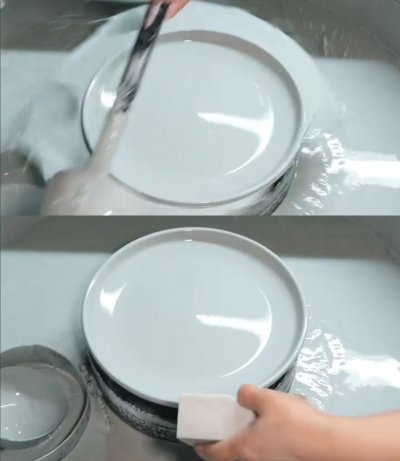
These plates are made at the HomeVSS factory in China. The plate is placed on a soft rubber-surfaced spinning wheelhead that is rotating fast enough that a ladle full of glaze poured into the center is expelled within a second and dries within four seconds. At the two-second mark, a sponge is used to catch drips and even coverage on the lip. The thixotropic character of the glaze enables the quick drying (since no CMC is needed). The plate is finished by a follow-up bottom-dip, using a suction cup holder. Finally, the lip is finished using a brush with the same glaze slurry. Watch this on Instagram using the link below.
Context: Glazing bone bisque-firing plates.., HomeVSS tableware factory in..
Wednesday 12th August 2026
How much Zircon does it take to make a glaze crawl?
For G2934 cone 6 matte glaze: As little as 5%

The Zircon needed to opacify glazes has a side effect: Crawling. Even low percentages can induce this issue when other factors interplay (as is the case here). It often happens at sharp concaves (e.g. inside bottom corners on mugs). But here it is on surfaces disturbed during formation of the spout. This G2934 recipe has good melt fluidity, so that is not the issue. The issue appears related to adherence of the initial laydown. Here are some questions to consider:
- Did the glaze crack on drying? Using some calcined kaolin, as specified in the recipe, helps reduce drying shrinkage.
- Is it applied too thick? If mixed as a thixotropic slurry (1.44 specific gravity, and gelled) it should go on evenly but thinner. And stick better.
- These areas that were disturbed during spout forming may require special attention to make sure the glaze adheres well (this is a Plainsman body, soluble salts that migrate to the surface during drying are affected by handling in the plastic and leather-hard states). Mix up some as a brushing glaze and apply a thin layer onto the bisque in the areas likely to crawl (the gum will ensure better adherence). Then dip the whole piece in the dipping glaze version.
- An 80:20 blend of G2934 and G2926B glossy will be less likely to crawl. The mix can be adjusted to enable tuning matteness to a drop-and-hold firing schedule.
- Use tin oxide as the opacifier instead of zircopax or superpax.
- Mix the batch as a base coat dipping glaze, then it will adhere better to the bisque.
- Reduce the amount of calcined kaolin (in the recommended recipe) in favor of raw kaolin (perhaps 5%) - that may produce a slurry with better coverage and adherence.
Context: Crawling in G2934Y Zircopax.., G2934 Cone 6 Matte.., An ordinary white mug.., Crawling
Wednesday 12th August 2026
Online Glaze Recipe Rescue:
Seeks good home for a magnesia blue
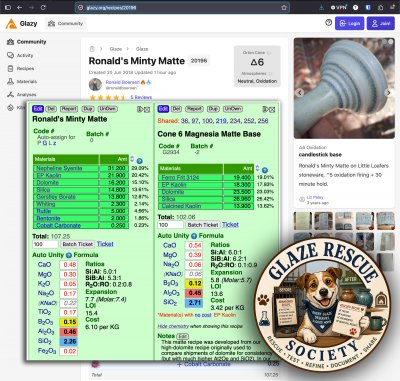
This "Minty Matte" glaze was found wandering in a Facebook group. With its excessive nepheline syenite coupled with very low SiO2 (thus high COE) it crazes on most clay bodies used by the potter who contacted me. Its tag traced it to Glazy 20196. I sometimes think of these as "shelter recipes", needing a "glaze rescue" after being caged and misunderstood online for years. This one could be deserving of a new home if given a little love! The love it needs is a simple understanding of the mechanism: It is just rutile saturation in a magnesia matte with a little cobalt to kick the blue. Recipes aren't carved in stone, the chemistry of this one can be altered to drop the COE a lot (by switching Na2O for MgO). I know that because G2934 magnesia matte also works with this mechanism. Transplanting it into that base would surely reduce crazing (with its 5.8 COE).
However, this recipe needs another rescue. From a misunderstanding. Although the potter contacting me was happy with the G2934 as a base for the rutile and cobalt, she had learned that durable glazes should have an R2O vs RO Ratio of around 0.3:0.7 (G2934 is 0.1:0.9). However, the R2O:RO ratio thing is misunderstood. Durability is much more about producing a well-melted homogeneous glass (but not over-fluid) with minimal phase separation and surface crystallization, good body fit and absence of large amounts of easily dissolved colorants.
Context: Titanium Dioxide in a.., 5 titanium dioxide in..
Wednesday 12th August 2026
The green underglaze bond is failing on impact

This is a fritted stoneware fired to cone 03. There is plenty of glass development to form a strong interface with glazes and underglazes. But this green commercial underglaze is not bonding well with the body. Repeated blows to the surface by a hammer (insufficient to break the piece but enough to test the glaze) are chipping off chunks of glaze/underglaze at the latter's interface with the body. This does happen with most other underglazes tested. The green underglaze is obviously more refractory and should be reformulated so that its stain medium develops enough fired maturity to counteract the refractory stain.
Context: Body glaze Interface
Tuesday 11th August 2026
Lithium and Spodumene prices are off-the-charts.
Can the percentage be reduced and still work?
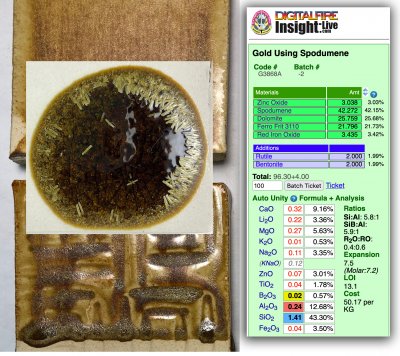
The crystals that form as this cone 6 fluid-melt glaze solidifies are one of the minerals in the recipe: Spodumene. Actually β-spodumene. But it is so expensive, and there is 42% here! What would it take to reduce the cost of making this glaze ($52/kg in 2026)? Another flux could certainly make it just as melt-fluid, but would not grow spodumene crystals.
β-spodumene is Li2O - Al2O3 - 4SiO2 So the 0.22 Li2O in this glaze would require 0.22 Al2O3 and 0.88 SiO2 to crystallize as a β-spodumene-type lithium aluminosilicate. The glaze contains 0.24 Al2O3 and 1.41 SiO2. There is almost exactly enough lithium to combine with nearly all of the alumina as β-spodumene. The 2% rutile supplies TiO2; it acts as a nucleating agent. Replacing Li2O with another flux could maintain the melt fluidity, but Na2O, K2O or B2O3 cannot simply take the place of Li2O in β-spodumene.
It is possible that less spodumene could still do this. That could be tested by reducing Li2O to 0.1 and increasing Na2O to 0.23 (while maintaining the other oxides as-is). B2O3 could also be tried (it has a far lower thermal expansion). Of course, effecting changes in specific oxides requires some glaze chemistry (e.g. in an Insight-live.com account).
Context: Li2O from Spodumene instead.., The positive side of..
Tuesday 11th August 2026
This underglaze is too thin to cover well.
I fixed it in under a minute. Sort of.

Right: My attempts to apply a layer of watery white underglaze to leather-hard clay. Not surprising that I measured the water content of this at 68%. Yikes!
Left: After adding about a gram of Epsom Salts (and blender-mixing it in to dissolve), the slurry became thixotropic and gelled enough to enable applying a thicker layer with no problem. Note how it stays on the spoon. However, there is still an issue: Multple layers are needed, with lots of drying time between them. The low solids loading of this product also makes it tricky to use on bisque ware (more time is needed between the thinner coats it creates). Allowing it to settle and pouring off water, or evaporating some of the water to raise the specific gravity, would make it even better.
Context: A reason for DIY.., This underglaze went on..
Monday 10th August 2026
This underglaze went on too thin:
It’s specific gravity is too low

Amaco V-303 Terra Cotta underglaze was applied in one coat at the leather-hard stage (on these Plainsman Snow mugs). It appeared to be thick enough on application and after bisque (left), but the clear overglaze on the right has diffused into it to melt it enough to lose its opacity. A higher specific gravity (lower water content) would make it possible to apply it thickly enough in one coat; this is especially important because each layer rewets the piece and adds a lengthy drying period. An appropriate specific gravity is thus the difference beween practical and impractical. Acheiving a better terra cotta texture and color is a prime candidate for DIY underglaze.
Context: Specific gravities on three.., Very low specific gravities.., This underglaze is too.., Specific gravity, Terra Cotta, Underglaze
Sunday 9th August 2026
Here’s why engobes shouldn’t melt
And also why they needn't contain zircon
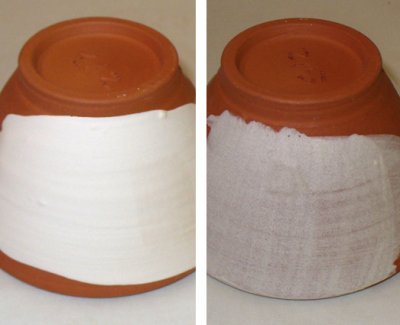
Since white burning slips are made from refractory materials they are not nearly as vitreous as terracotta bodies, they need help to mature and a frit is the natural answer. With the right amount, fired shrinkage can be matched to the body while the slip remains opaque.
L3685A slip on the left: An adjustment to the popular "Fish Sauce" recipe (which is basically a super plastic white body). 8% Frit 3110 replaces 8% Pyrax to make it glass-bond to the body better while remaining completely opaque.
Right L3685C: It has 15% frit, moving it into glaze territory, with translucency replacing opacity. Although expensive zircon could be added to restore opacity, that doesn’t fix the excessive firing shrinkage it now has, mismatching it with the body (which becomes more eventful the thicker it is applied).
Context: L3685U, Creating a Non-Glaze Ceramic.., Color matching restoration project.., White engobe flaking off.., A reason for DIY.., Applying an engobe by.., Potters can learn from.., Bi-Clay strips test compatibility.., Opacity, Engobe
Friday 7th August 2026
Making test bars of an underglaze:
This cone 04 and 6 bar are within its range! How?
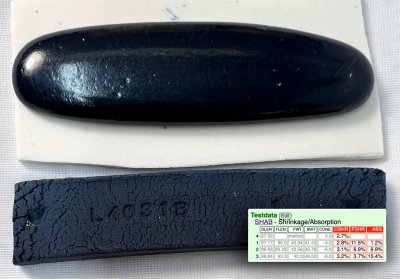
This was an effort to do SHAB test bars, at various temperatures to form a fired maturity profile of a blue commercial underglaze. It did not go as planned. It was very difficult to make these bars because the product has such a high content of gum. This dramatically impedes drying and it is impossible to form and dry them (they split and crack into many pieces). So I crushed and ball milled the dried scraps, roasted the powder to 1000F to destroy the plasticity, then added enough bentonite to be able to make them plastic enough to form the test bars.
Notice that at cone 06, the absorption is 15.4% with 3.7% fired shrinkage. By cone 04, the bottom bar, that is down to 1.2% porosity and up to 11.% shrinkage (basically a colored porcelain). The top bar is fired to cone 6, and melts (like others at previous cones).
Both of these are within its claimed firing range. So what does "within that range" mean? They mean "true-to-color", it is the same color throughout the range. But that bottom bar, cone 04, is at the edge of what an underglaze should be ceramically (if applied in multiple layers that build up a thickness).
Context: Make AMACO velvet underglazes.., DIY Underglaze Development
Wednesday 5th August 2026
The demise of USG plasters!
If true, this is seismic for ceramics.
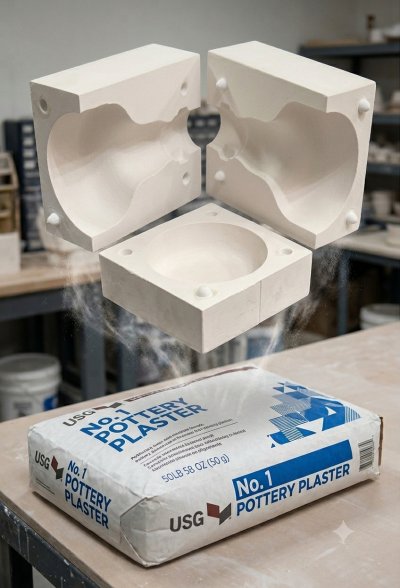
The ceramic industry depends on some surprisingly specialized materials made by very few companies. When one of those companies exits the market, we need to notice. Consider how much of ceramics depends on plaster: slip casting of pottery and sanitaryware, jiggering, RAM pressing, mold making and countless studio processes. Yet plaster is so inexpensive and familiar that we tend to forget how technologically specialized—and indispensable—it actually is. USG #1 Pottery Plaster has been an industry standard for generations.
The Bad News
USG is closing its historic Southard, Oklahoma gypsum operation, apparently ending production of a wide range or specialty plasters including #1 Pottery Plaster, Hydro-Stone, Ultracal, Hydrocal, Puritan. This is a potentially seismic event for ceramics.There is Hope
The core mineral in wallboard and pottery plaster is calcium sulfate hemihydrate. Historically, some gypsum plants produced both wallboard stucco and pottery plaster from the same gypsum source, separating the streams after calcination and tailoring each to its intended application. So maybe USG could make No. 1 Pottery Plaster at one of its wallboard plants. Unless there is something unique about the Southard process or the raw gypsum or reports of them "ceasing all industrial plaster operations" are accurate.There is an Alternative
Fortunately, there is another major North American producer: Georgia-Pacific. Its K-59 Pottery Plaster is a remarkably close counterpart to USG #1, having essentially the same normal water/plaster ratio and density, with similar strength and expansion. Without products like these from Georgia-Pacific, the USG withdrawal could have been a genuine supply-chain earthquake for ceramics. Instead, it should be a wake-up call.Cautious Optimism
Georgia-Pacific has a long-established Industrial Plasters division with dedicated sales managers covering both the U.S. and Canada. GP already manufacture pottery and tooling plasters, ceramics is one of the industries they explicitly target. If they decide to embrace the opportunity, they would become the primary North American supplier of specialty ceramic plasters. The biggest uncertainty is whether they can produce enough to replace what USG has historically supplied. And whether ceramic suppliers will begin stocking much larger inventories.Context: Plaster, US Gypsum Co, Beer Bottle Master Mold..
Thursday 30th July 2026